Neo-Marxist German philosopher Jürgen Habermas has died; see Jürgen Habermas, influential German philosopher, dies at 96Jürgen Habermas, influential German philosopher, dies at 96 (AP, March 14, 2026).
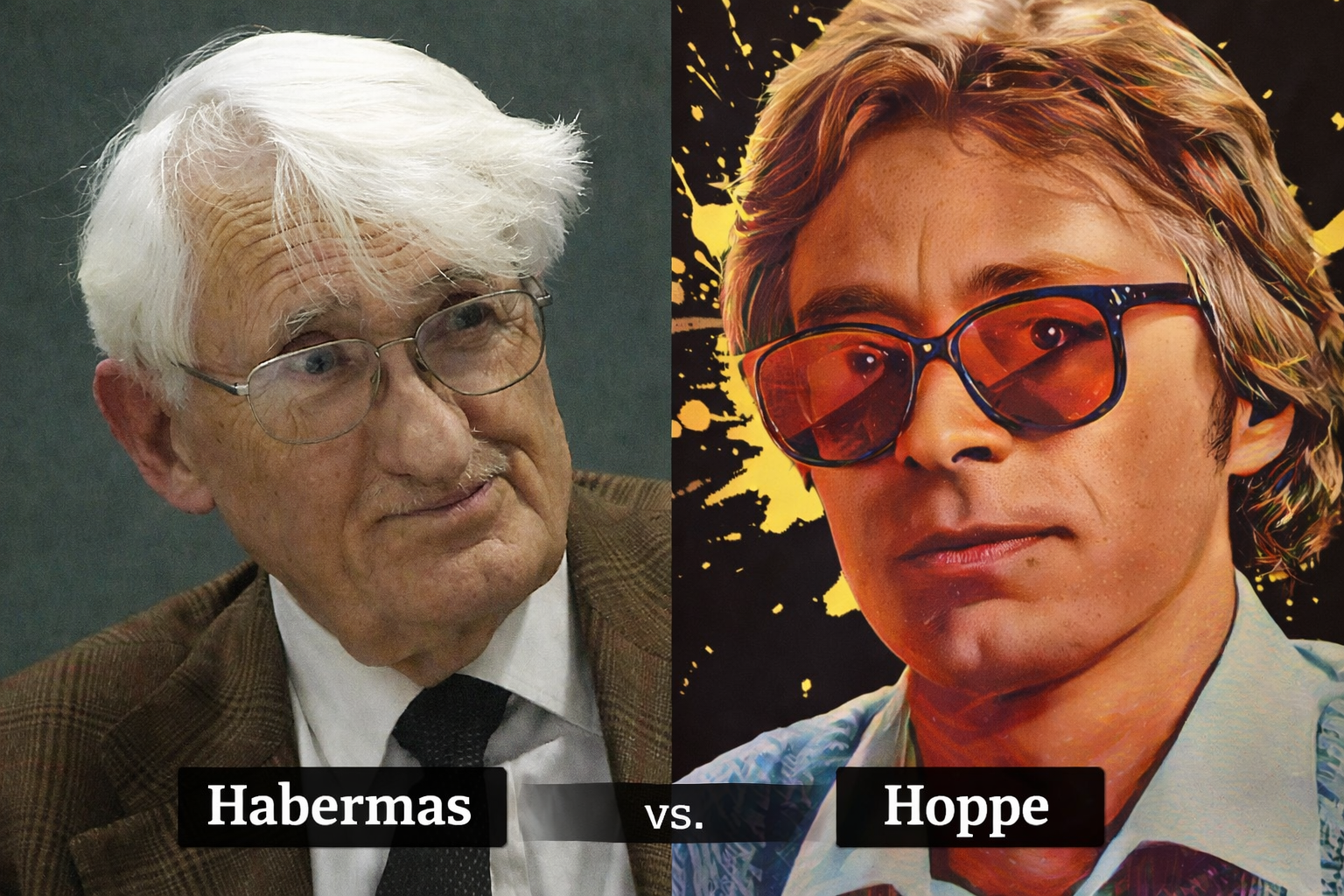 As admirers of Hans-Hermann Hoppe know, Habermas was one of Hoppe’s teachers and the principal advisor for his doctoral dissertation in Philosophy on David Hume and Immanuel Kant at Goethe-Universität, Frankfurt am Main from 1968–1974, Handeln und Erkennen [Action and Cognition] (Bern 1976) ). (At the time of time of his PhD dissertation, Hoppe was 24. He regards his “habilitation” thesis, written by the time he has reached intellectual maturity, and of course later work, as far more important than the PhD dissertation.)1 Hoppe soon abandoned the leftism of Habermas and the Frankfurt School and adopted Misesian Austrian economics and Rothbardian anarchist libertarianism. As Grok and ChatGPT recognize, Hoppe is Habermas’s most famous but politically most distant student (other prominent students of Habermas including more aligned figures like Axel Honneth, Rainer Forst, Claus Offe, and Hans Joas).
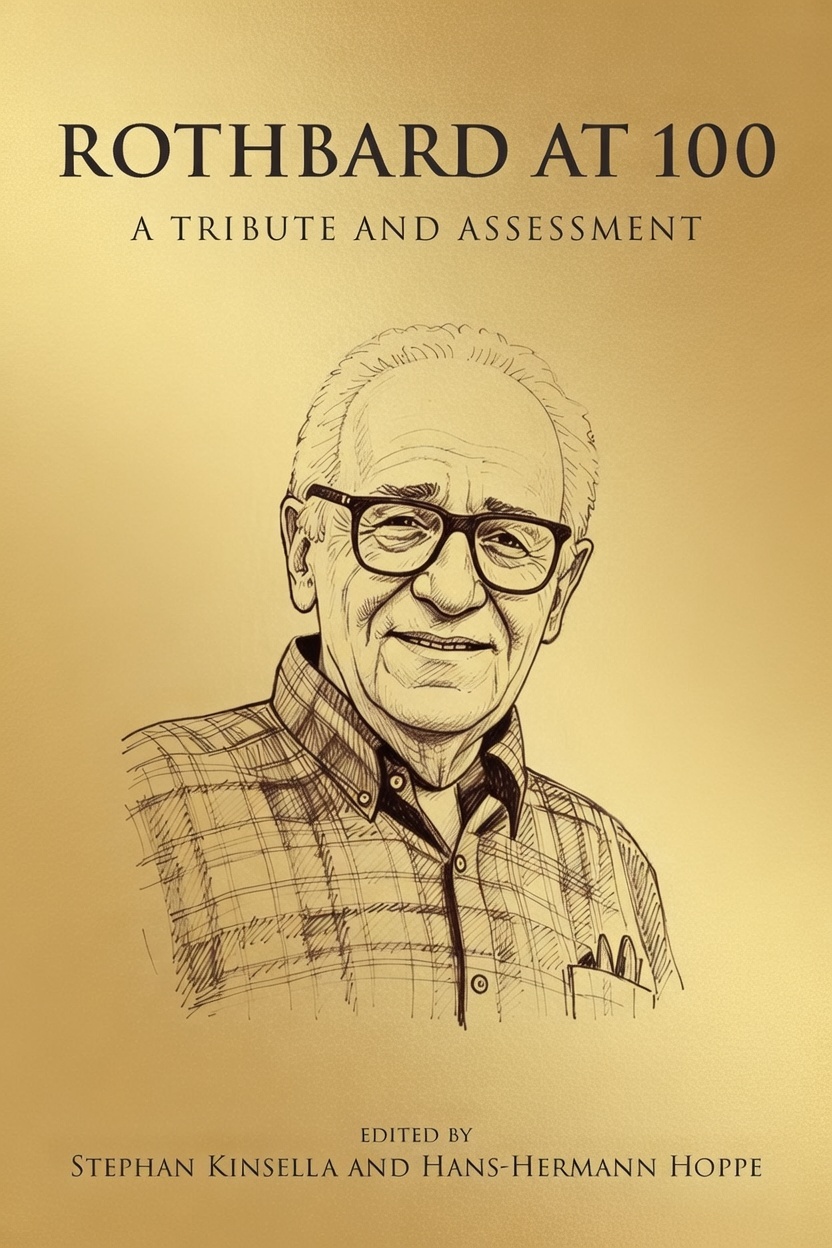
One thing Habermas became known for was his “discourse ethics”;2 Hoppe later relied to some degree on aspects of this theory, and to a greater degree on the more coherent and fleshed out views of fellow leftist German philosopher Karl-Otto Apel,3 in developing his own “argumentation ethics” radical defense of libertarian rights.4 Some Hoppe critics have overstated impact of Habermas’s ideas on Hoppe’s views; for example, back in 2019, Hoppe-basher Phil Magness made a confused attempt to try to link Hoppe’s views on immigration to his Habermas, even though analysis of democracy and immigration and related views has nothing whatsoever to do with Habermas.5 Even Hoppe’s rights theory has only a slight connection to Habermas; Hoppe was actually not even aware of Habermas’s discourse ethics when studying under him. Hoppe is not a Habermasian; he is a Misesian and Rothbardian. And his work is far more important, coherent, and salient for human liberty than that of Habermas. (For his more recent publication, see Rothbard at 100: A Tribute and Assessment, Stephan Kinsella and Hans-Hermann Hoppe, eds. (Papinian Press and The Saif House, 2026).)
Update: See Tom DiLorenzo’s re-post at LewRockwell.com.
For a few related comments about Hoppe and Habermas, see:
Sean Gabb, “Introduction,” in Hans-Hermann Hoppe, Getting Libertarianism Right (Auburn, Ala.: Mises Institute, 2018), pp. 7–8, 10:
After attending various local schools, he first went to the University of Saarland in Saarbrücken and from here moved to the Goethe University in Frankfurt, where he studied under the notable neo-Marxist Jürgen Habermas, who also served as the principal advisor for Hoppe’s doctoral dissertation in Philosophy on David Hume and Immanuel Kant. … What Hoppe tries with his Argumentation Ethics, is to transcend this debate. In doing this, he draws on his early work with Habermas, on the Kantian tradition of German Philosophy, and on the ethical writings of Rothbard.
Hoppe, PFP163 | Hans Hermann Hoppe, “On The Ethics of Argumentation” (PFS 2016):
The one subject, where I consider my contribution the most important: the apriori of argumentation as the ultimate foundation of law.
I developed the central argument during the mid-1980s, in my own mid-thirties. Not from scratch, of course. I took up ideas and arguments previously developed by others, in particular my first principal philosophy teacher and Doktorvater, Jürgen Habermas, and even more importantly Habermas’ long-time friend and colleague, Karl-Otto Apel, as well as by the philosopher-economists Ludwig von Mises and Murray Rothbard. In any case, however, the argument I ultimately developed appeared to me essentially new and original. (Around the same time, Frank van Dun, living in Flanders and writing in Dutch, and having been brought up in very different philosophical circumstances and traditions, had come up with a very similar argument and conclusion. Yet at the time, we both did not know of each other’s work and would only find out years later.)6
The Brazilian Philosophy Magazine Dicta & Contradicta Interviews Hans-Hermann Hoppe (July 15, 2013):
What positive influence did Habermas have on your thought? Were there negative influences from him as well?
Hoppe: Habermas was my principal philosophy teacher and Ph.D. advisor during my studies at the Goethe University in Frankfurt am Main, Germany, from 1968-74. Through his seminars I became acquainted with British and American analytical philosophy. I read K. Popper, P. Feyerabend, L. Wittgenstein, G. Ryle, J.L. Austin, J. Searle, W.v.O. Quine, H. Putnam, N. Chomsky, J. Piaget. I discovered Paul Lorenzen and the Erlangen school and the work of K.O Apel. I still believe that this was a pretty good intellectual training.
Personally, then, I have no regrets. As for Habermas’ influence on Germany and German public opinion, however, it has been an unmitigated disaster, at least from a libertarian viewpoint. Habermas is today Germany’s most celebrated public intellectual and High Priest of “Political Correctness:” of social democracy and welfare-statism, of multi-culturalism, anti-discrimination (affirmative action) and political centralization spiced, especially for German consumption, with a heavy dose of “anti-fascist” rhetoric and “collective guilt”-mongering.
Hoppe, My Discovery of Human Action and of Mises as a Philosopher:
I started out in my intellectual development as a left-winger. … I entered the university in 1968, at the height of the anti-Vietnam-war protests and the wide-spread student rebellions all across the US and Europe. As a typical product of the Zeitgeist, then, I was one of those youngsters who were later-on, until today, called-out as a member of the 1968er generation, blamed for the successive left-ward turn of Germany (and the West, generally), by a “march through the institutions” recommended by the Italian Commie Antonio Gramsci, that is still continuing to this day—but with some hopeful signs appearing on the horizon that the end of the rope may be near. In any case, my leftism at the time was not so much motivated by egalitarian sentiments but the belief in the greater efficiency of some sort of central economic planning (rather than the “anarchy of markets”).
My main field of university study originally was Philosophy, and my main teacher at the time was Jürgen Habermas, 20 years older than myself, and at that time the young, rising star of the famous “Frankfurt School” of the so-called “Critical Theory.”
… I absorbed all or most their work [that of the Frankfurt School], and Habermas, who from his early beginnings as an enfant terrible has in the meantime risen to the rank of one of the most famous and highly decorated philosophers not only in Germany, but world-wide, and the high-priest of political correctness, welfare-statism and US-led political centralization, became my Doktor-Vater.
Hoppe, My Path to the Austrian School of Economics:
Jürgen Habermas, at that time the rising young star of the new left and today the high priest of social democratic statism and politically correct virtue-signalling, became my most important first philosophy teacher and dissertation supervisor. In 1974, the year of my PhD, my socialist phase was of course already over, and my dissertation on an epistemological topic—a critique of empiricism—had nothing to do with socialism or ‘the “left.”
Hoppe, On War, Democratic Peace, and Reeducation: The “German Experience” in Reactionary Perspective: describing Habermas as the long-time intellectual front-man or “High Priest” of the Frankfurt School, who—after a temporary falling out with Horkheimer over being seen as insufficiently reformist and Western—was rehabilitated by proving his commitment to the “revisionist” model of the Western Welfare State, thereby contributing to Germany’s postwar re-education toward anti-nationalist, egalitarian, and social-democratic ideals that Hoppe views critically in the context of democratic peace and societal decline.
Hoppe and Tom Woods, Letter: The Hans Hoppe Interview (2025):
Tom Woods: Hans Hoppe, thanks so much for talking with us. I’d like to start by asking you to describe your educational and ideological background; I know you began your career as a left-winger.
Hans-Hermann Hoppe: I finished high school in 1968, which was the height of the student rebellion in the United States and also in Germany, in France, actually all over Europe. And I was some sort of left winger—not so much because of egalitarian motivations, but more because I was convinced that a planned economy would be more efficient than some anarchistic market market economy.
Because of that, I went to the University of Frankfurt, which at that time, next to the Free University of Berlin, was one of the most left-wing places. And I decided to study philosophy. I was close to Jurgen Habermas, who at that time was the rising star of the Frankfurt School. He offered me very quickly the opportunity to write a dissertation with him. So I became one of his students in the meantime, and probably one of his most famous students, even though I eventually turned away from the thinking of my early days.
The reason for that was, on the one hand, my experience with East Germany. My parents were both refugees. My mother’s parents were expropriated by the Russians in 1946. They were major landowners. Most of my relatives lived in East Germany and we visited them every year. And I saw what sort of mess that whole thing was. So I turned away from the idea that the planned economy was great, because I saw the results of it.
I then looked around for alternatives. And the most prominent non-socialist people at that time in Germany were Milton Friedman, by far, and then second, maybe Hayek. My dissertation that I wrote under Habermas had nothing to do whatsoever with leftist politics anymore. It was concerned with a critique of empiricism from the point of view of the rationalist school, represented by people like Kant, for instance.
In the German system, after your dissertation, if you want to pursue an academic career the next step is to write an habilitation thesis, like an advanced doctoral degree. Once you finish that, you get the title of a Privatdozent. That was also the title that Mises had for a long time in Vienna. It gives you the status of a professor. You can take on doctoral students, you can teach courses at the university, but you are unsalaried.
In any case, my habilitation thesis was on the method of the social sciences, including economics. That was the first time that I became acquainted with economics. I discovered that most economists adopted the view that I knew as a philosophy student, of the so-called Vienna School or of of the Popperite version of the Vienna School—namely, that all statements in economics are empirical, testable or falsifiable statements.
I thought that was clearly wrong. I thought statements like, if you increase the supply of money, then the purchasing power of money will decline, were things that seemed to be logically true, that didn’t need to seek any falsification. I also discovered other statements that clearly did not qualify as empirical statements, such as: a person cannot be in two places at the same time. This was not a statement that wasjust a linguistic convention, but it was a statement that was true about some real thing. Every detective uses this principle; in every detective story, you find it. The first thing they do is to look: does the accused have an alibi? Was he at that place where the murder occurred at the time when it occurred? Or was he someplace else (in which case, of course, he would have to be innocent)? So there are plenty of statements that are not empirical statements in the way that the logical positivists in Vienna, the Popperites, held that all statements have to be.
Then I discovered Ludwig von Mises. I found out that Mises held precisely this view. There are economic statements—he called them a priori statements. And that wassomething that also existed, of course, in Kant. And I had studied Kant in my critique of empiricism, especially of David Hume. So I thought there was nothing strange about a priori statements. So, yes, economics has a priori statements that cannot be refuted by experience, but they are logically true. So I became a Misesian.
Then I discovered Murray Rothbard.
- For his “Habilitation” thesis, in Sociology and Economics, from Goethe-Universität, Frankfurt am Main, in 1981, see Hans-Hermann Hoppe, Kritik der kausalwissenschaftlichen Sozialforschung: Untersuchungen zur Grundlegung von Soziologie und Ökonomie [Critique of Causal Scientific Social Research: Studies on the Foundation of Sociology and Economics] (Opladen: Westdeutscher Verlag, 1983); Kinsella, Hoppe’s Habilitation Thesis: Critique of Causal Scientific Social Research. [↩]
- See Kinsella, Revisiting Argumentation Ethics; Discourse Ethics entry in Wikipedia (which yours truly started, and which has more on Hoppe and Habermas). [↩]
- Kinsella, Hoppe’s Argumentation Ethics and Its Critics. [↩]
- Hoppe, My Discovery of Human Action and of Mises as a Philosopher; PFP163 | Hans Hermann Hoppe, “On The Ethics of Argumentation” (PFS 2016), and other references in Kinsella, “Argumentation Ethics and Liberty: A Concise Guide” (2011) and Supplemental Resources. [↩]
- See Magness on Hoppe; the Kochtopus and the Mises Caucus; see also Prychitko on Habermas and Austrianism: Where’s Hoppe?; Hoppe: Habermas’s Anarcho-Conservative Student. [↩]
- See Frank Van Dun; “Argumentation Ethics and The Philosophy of Freedom”; also Kinsella, “Argumentation Ethics and Liberty: A Concise Guide”; idem, “Dialogical Arguments for Libertarian Rights,” “Defending Argumentation Ethics,”, and “The Undeniable Morality of Capitalism,” all in Legal Foundations of a Free Society (Houston, Texas: Papinian Press, 2023). [↩]














 Doug French
 Fernando Chiocca
 Hans-Hermann Hoppe
 Jay Baykal
 Juan Fernando Carpio
 Martin Cabrera
 Oscar Grau
 PFS
PFS Stephan Kinsella
 Tom DiLorenzo