PFS 2026, the Annual Meeting of the Property and Freedom Society, hosted by Drs. Gülçin & Hans Hoppe, will be held from Thursday, September 17, 2026 to Tuesday, September 22, 2026. As the inaugural meeting was held in 2006 and the 2020 meeting was canceled due to covid restrictions, this will be the twentieth annual meeting of the PFS held over the past twenty years.
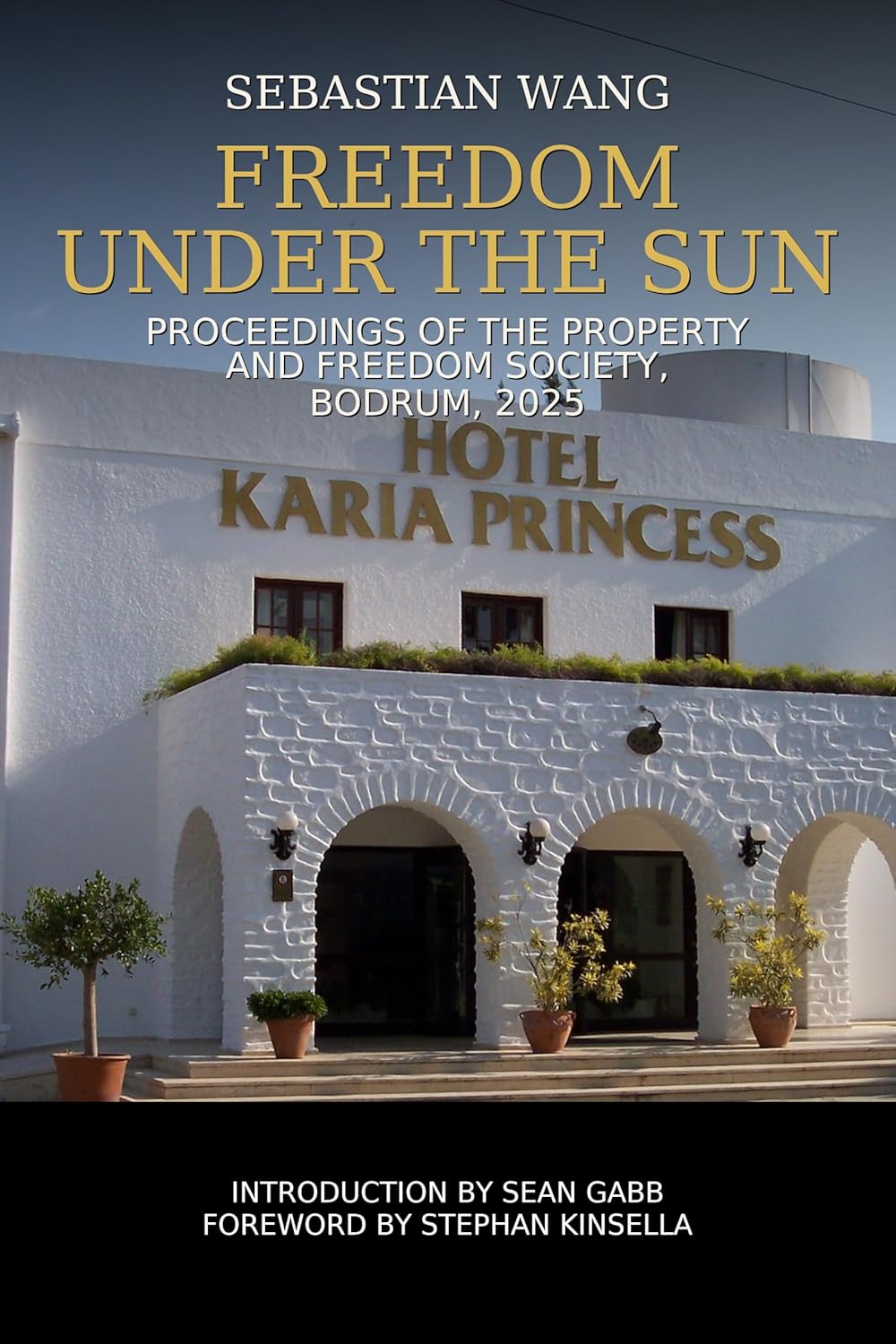
Past events have been held in Bodrum, Turkey, at the Hotel Karia Princess. Because of some uncertainties in Turkey regarding new regulations on hotels, we are hopeful to hold the event again at the Karia; we will confirm the exact situs presently.
PFS Members/returning guests, or those interested in obtaining an invitation for this upcoming annual meeting of our exclusive annual salon, should write to the PFS secretary Mr. Thomas Jacob ([email protected]) (Administrative Secretary/Membership), regarding conditions, availability, and requirements.
The tentative list of speakers for the 2026 Annual Meeting is provided below and will be supplemented presently. For information about previous annual meetings, see here, the PFS Youtube channel and the Property and Freedom Podcast.
Speakers and Topics
[Topics and other speakers TBA]
- Hans-Hermann Hoppe (Germany/Turkey)
- Saifedean Ammous (Palestine/Jordan)
- Anthony Daniels (Theodore Dalrymple) (England), The Rise of Monomaniac Movements as a Threat to Liberty
- Thomas J. DiLorenzo (USA)
- David Dürr (Switzerland): “Freedom of Will—A Useful Illusion”1
- Michael Esfeld (Switzerland): The Foundation of Freedom: The Transcendental Argument2
- Alessandro Fusillo (Italy): Adolf Reinach and his “A Priori Foundations of the Civil Law”3
- Sean Gabb (England)
- Tim Haffner (USA/Japan): Japan’s Last Samurai: A Revolution Betrayed
- Guido Hülsmann (Germany/France)
- Stephan Kinsella (USA): Adolf Reinach and his “On The Concept of Causality in the Criminal Law”4
- Olivier Richard (Switzerland): Is Darwin Dead?
- Rahim Taghizadegan (Austria/Switzerland): Paternalism and Liberty in an Age of Infantilization
- Andreas Tögel (Austria): The Meaning of Left and Right in Modern Times
Schedule/Format
Thursday, September 17, 2026
arrivals and registration
Dinner (pool area)
Friday, September 18, 2026
- Gülçin Imre Hoppe (Turkey) & Hans-Hermann Hoppe (Germany/Turkey): Welcome and Introductions
Book Presentation [tba]
Reception and Dinner at the Hotel
Saturday, September 19, 2026
Dinner at the Hotel
Sunday, September 20, 2026
Gala Dinner at the Hotel
Monday, September 21, 2026
Gulet Boat Excursion. Swimming. Lunch on the Boat (Walk to the Marina)
Dinner at the Hotel
♠ ♠ ♠
About the PFS
The Property and Freedom Society (Facebook; Twitter) was established in May, 2006 at the initiative of world-renowned libertarian philosopher and Austrian economist Hans-Hermann Hoppe. The Inaugural Meeting and subsequent annual meetings have been held at the Hotel Karia Princess in Bodrum, Turkey. Programmes and video of previous presentations are available here.
The PFS is an international society for the promotion of “Austro-Libertarianism,” the economic and social philosophy most prominently represented during the 20th century by the Austrian economist Ludwig von Mises and his leading American student Murray N. Rothbard, and tying back to the 19th century French economists Frederic Bastiat and Gustave de Molinari.
As such, the PFS stands for an uncompromising intellectual radicalism: for justly acquired private property, freedom of contract, freedom of association—which logically implies the right to not associate with, or to discriminate against—anyone in one’s personal and business relations—and unconditional free trade. It condemns imperialism and militarism and their fomenters, and champions peace. In the words of Professor Hoppe in 2010, at the Fifth Annual Meeting:
After the first meeting, 5 years ago, here at the Karia Princess, my plan became more specific still. Inspired by the charm of the place and its beautiful garden, I decided to adopt the model of a salon for the Property And Freedom Society and its meetings. The dictionary defines a salon as “a gathering of intellectual, social, political, and cultural elites under the roof of an inspiring hostess or host, partly to amuse one another and partly to refine their taste and increase their knowledge through conversation.” Take the “political” out of this definition—and there you have it what I have tried to accomplish for the last few years, together with Gülcin, my wife and fellow Misesian, without whose support none of this would be possible: to be hostess and host to a grand and extended annual salon, and to make it, with your help, the most attractive and illustrious salon there is. [Video here and streamed below]
For further information, see:
-
-
- PFS, History and Principles
- Hoppe, The Property And Freedom Society—Reflections After Five Years, The Libertarian Standard (June 10, 2010)
- Hoppe, The Role of the Property and Freedom Society in a Crazy World (May 21, 2009, Property and Freedom Society 2009 Annual Meeting Introductory Speech, Bodrum, Turkey)
- Hans-Hermann Hoppe & Gulcin Imre Hoppe, 2006–2015: PFS, Now and Then
- Hoppe, Tom Woods Elite Letter: The Hoppe Interview: PFS Comments
- Sean Gabb, 10 Years of PFS
-
PFP046 | Hans-Hermann Hoppe, The Property And Freedom Society—Reflections After Five Years (PFS 2010)
♠ ♠ ♠
For further information about the PFS and its previous meetings, see the Press & Offsite Material page, and various articles such as:
-
- Hoppe, Tom Woods Elite Letter: The Hoppe Interview: PFS Comments
- Juan Fernando Carpio, “PFS 2025: Cozy, Inspiring, Invigorating: My Thoughts on This Year’s PFS Meeting,” Property and Freedom Blog (Oct. 20, 2025)
- Martín Cabrera y Marisa Jarquin, “First Guatemalans at the PFS,” Property and Freedom Blog (Oct. 15, 2025)
- Sebastian Wang, “Bodrum 2025: Reflections on a Journey,” Libertarian Alliance [UK] Blog (Sep. 24, 2025)
- Thomas DiLorenzo, “The Preeminent Libertarian Meeting of the Year,” LewRockwell.com Blog (Sep. 13, 2025)
- Doug French, “The Turkish Way,” Mises Wire (Oct. 11, 2022)
- Stephan Kinsella, “Doug French on “The Turkish Way” (PFS 2022)“
- Stephan Kinsella, Property, Freedom, and Defiance: PFS 2021 in a Covid World (Oct. 1, 2021)
- Sean Gabb: The Twelfth Conference of the Property and Freedom Society (PFS 2017) (22 Sept. 2017)
- X: The Only Conference Worth Attending: A Personal Account of the 11th Conference of the Property & Freedom Society (Sept. 10, 2016)
- Gabb: Notes from the Eleventh [2016] Conference of the Property and Freedom Society (Sept. 7, 2016)
- Sean Ring: The Chief Event (Oct. 4, 2012)
- Andy Duncan: Inside the conspiracy: Property and Freedom Society, Bodrum, Turkey, 2012 (Oct. 3, 2012)
- Doug French on PFS 2012: The World’s Greatest Haircut (Oct. 2, 2012)
- Jeff Tucker on PFS 2012: The Center of the Conspiracy (Sep. 29, 2012)
- June 8, 2011: “Outside the Asylum: Property and Freedom Society, Bodrum, Turkey, 2011,” by Andy Duncan, Cobden Centre (republished as “A Few Days outside the Asylum,” Mises Daily, June 15, 2011)
- June 17, 2010: “Reflections on the 2010 Conference of the Property and Freedom Society,” by Sean Gabb, Free Life Commentary, Issue Number 194
- June 16, 2010: “Bodrum Days and Nights: The Fifth Annual Meeting of the Property and Freedom Society: A Partial Report,” Stephan Kinsella, The Libertarian Standard
- July 4, 2008: “The Third Meeting of the Property and Freedom Society, Bodrum, May 2008: A Brief Record,” Sean Gabb, Free Life Commentary No. 173
- June 4th 2007: Report on the second PFS conference in Bodrum [local copy], by Rahim Taghizadegan, liberty.li (in German)
- June 21st 2006: Hoppean Property and Freedom by Doug French, LewRockwell.com
- June 14th 2006: The Inaugural Meeting of the Property and Freedom Society: An Incidental Record, by Sean Gabb, Free Life Commentary, Issue Number 148
- KOL293 | Faith and Free Will, with Steve Mendelsohn [↩]
- See Kinsella, Argumentation Ethics and Liberty: A Concise Guide. [↩]
- See also Adolf Reinach’s “The Apriori Foundations of the Civil Law”. [↩]
- See also Reinach, “On The Concept of Causality in the Criminal Law”; Stephan Kinsella and Patrick Tinsley, “Causation and Aggression,” Q. J. Austrian Econ. 7, no. 4 (Winter 2004): 97–112; Kinsella, Causation, Aggression, the Law, and Reinach; Hans-Hermann Hoppe, “Property, Causality, and Liability,” Q. J. Austrian Econ. 7, no. 4 (Winter 2004): 87–95, reprinted in Hoppe, The Great Fiction: Property, Economy, Society, and the Politics of Decline, Second Expanded Edition (Auburn, Ala.: Mises Institute, 2021); Jörg Guido Hülsmann, “The A Priori Foundations of Property Economics,” Q. J. Austrian Econ. 7, no. 4 (Winter 2004): 41–68; Larry J. Sechrest, “Praxeology, Economics, and Law: Issues and Implications,” Q. J. Austrian Econ. 7, no. 4 (Winter 2004): 19–40; Walter Block, “Austrian Law and Economics: The Contributions of Adolf Reinach and Murray Rothbard,” Q. J. Austrian Econ. 7, no. 4 (Winter 2004): 69–85. [↩]









 Doug French
 Fernando Chiocca
 Hans-Hermann Hoppe
 Jay Baykal
 Juan Fernando Carpio
 Martin Cabrera
 Oscar Grau
 PFS
PFS Stephan Kinsella
 Tom DiLorenzo